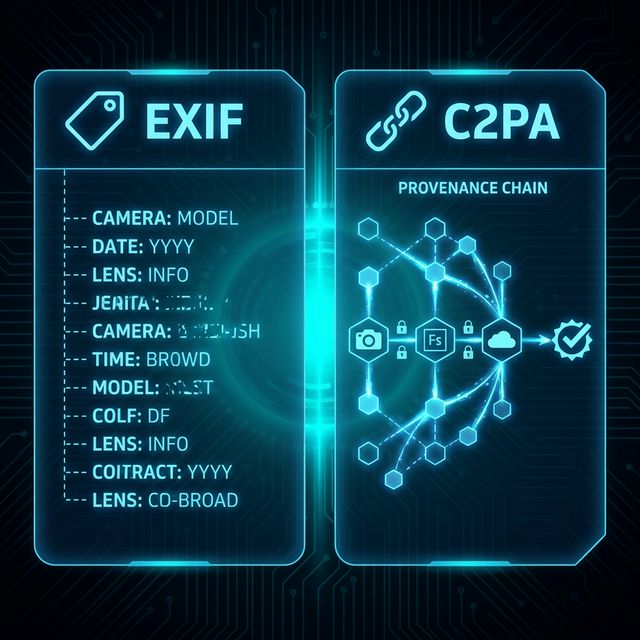
EXIF: The Legacy Standard
EXIF (Exchangeable Image File Format) has been the primary image metadata standard since the 1990s. It stores technical information about how a photo was taken:
- Camera make, model, and lens
- Exposure settings (aperture, shutter speed, ISO)
- GPS coordinates and timestamps
- Thumbnail previews
The Problem with EXIF
While EXIF is widely supported, it has critical limitations:
- No cryptographic signing — EXIF data can be easily modified or stripped
- No provenance chain — No way to track editing history
- No tamper detection — Can't verify if metadata has been altered
- Privacy concerns — GPS data can expose location without consent
C2PA: The Modern Alternative
C2PA addresses every limitation of EXIF by providing:
- Cryptographic signatures — Manifests are digitally signed, making tampering detectable
- Provenance chain — Full history of who created and edited the content
- Tamper evidence — Any modification to the manifest invalidates the signature
- AI transparency — Specifies whether content was AI-generated via digitalSourceType
Can They Work Together?
Yes! C2PA and EXIF are complementary. EXIF provides technical camera data while C2PA provides provenance and authenticity. A well-documented image should have both — EXIF for the technical details and C2PA for the trust chain.
The Future
As AI-generated content becomes more prevalent, C2PA is positioned to become the industry standard for digital trust. Major camera manufacturers like Nikon, Canon, and Leica are already embedding C2PA data at capture time.