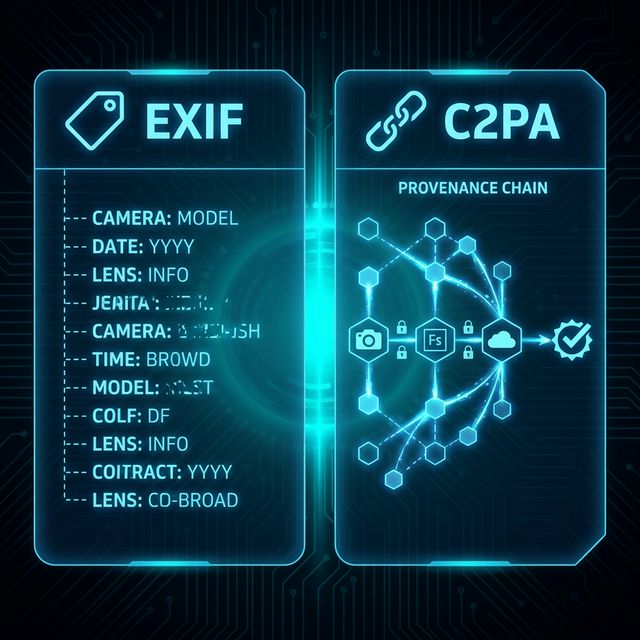
What is C2PA?
C2PA stands for Coalition for Content Provenance and Authenticity. It is an open technical standard that provides a tamper-evident way to trace the origin, history, and modifications of digital content such as images, videos, audio, and documents.
Founded in 2021, C2PA unites major technology companies including Adobe, Microsoft, Google, Intel, BBC, and Sony to combat misinformation by making content provenance transparent and verifiable.
How Does C2PA Work?
C2PA works by embedding a manifest — a cryptographically signed data structure — directly into media files. This manifest contains:
- Assertions — Claims about how the content was created or edited
- Digital Signatures — Cryptographic proof that verifies the manifest hasn't been tampered with
- Ingredients — References to source materials used to create the content
- Actions — A log of editing operations performed on the content
Why C2PA Matters
In an era where AI can generate photorealistic images and deepfakes are becoming more sophisticated, C2PA provides a critical layer of trust. It allows:
- Journalists to verify the origin of photographs
- Social media platforms to flag AI-generated content
- Photographers to prove ownership and authenticity
- Consumers to make informed decisions about the content they consume
C2PA vs Content Credentials
Content Credentials is the consumer-facing brand name for C2PA technology, introduced by the Content Authenticity Initiative (CAI). While C2PA is the technical standard, Content Credentials is the user-friendly term you'll see in tools like Adobe Photoshop and Lightroom.
How to Check C2PA Data
You can use tools like C2PA Checker to upload an image and instantly view its embedded C2PA manifest, verify signatures, and detect if it was created by an AI tool.